
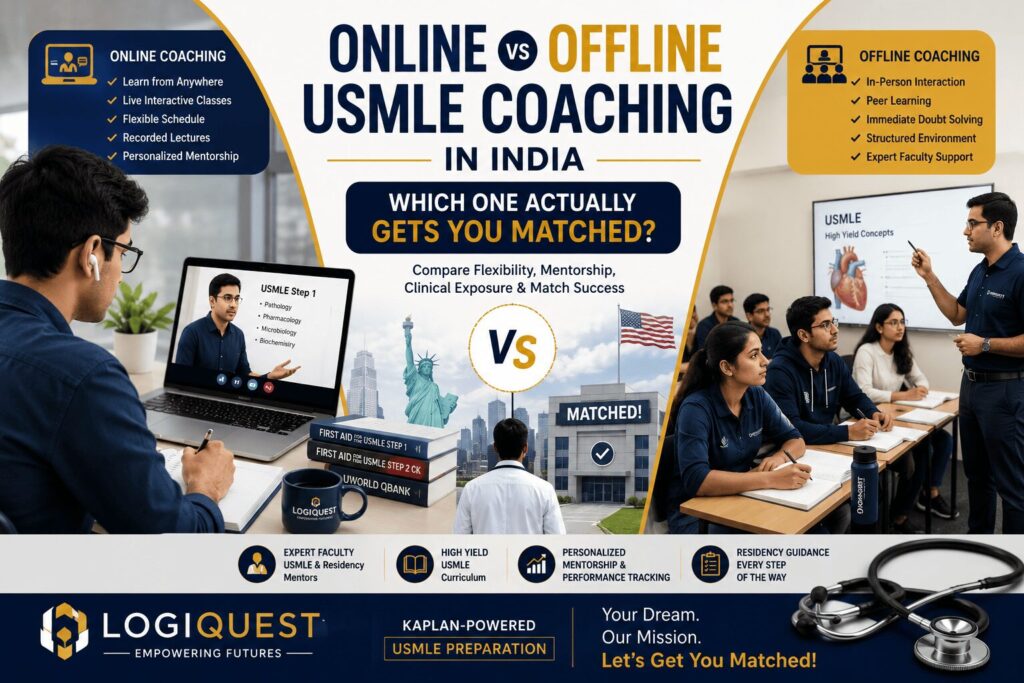
For most Indian medical students and IMGs, online USMLE coaching gets you matched more reliably than offline coaching because the Match now rewards a high Step 2 CK score, daily question practice, and flexible scheduling that fits clinical postings, none of which depend on sitting in a physical classroom.
Offline coaching wins only for students who genuinely need enforced structure and in-person accountability. The format matters far less than the quality of the program and your own consistency. The best USMLE coaching in India today is usually hybrid: online content with structured mentorship and accountability.
If you’re choosing between online and offline USMLE coaching in India, you’re really asking a bigger question: which path actually ends in a US residency match and which one just feels productive?
This guide answers that directly, using current 2026 Match data, and gives you a decision framework based on your situation rather than generic advice
The short version: format is a tool, not the strategy
Here’s what the data makes clear. In the 2026 Main Residency Match the largest in NRMP history, with over 53,000 registered applicants and 44,344 positions offered what separated matched IMGs from unmatched ones was almost never where they studied. It was their Step 2 CK score, their clinical experience, and the consistency of their preparation.
Since USMLE Step 1 went pass/fail in January 2022, and the Step 2 CK passing standard rose to 218 (effective July 1, 2025), Step 2 CK has become the single most important number on your ERAS application. Non-US IMGs who matched in the recent cycle averaged roughly 248 on Step 2 CK well above the new passing line.
No classroom, online or offline, hands you that score. The right format is simply the one that helps you build it. So the real comparison isn’t “online vs offline” it’s “which format removes the most friction between you and 6–9 months of disciplined Qbank-driven prep.
What does “USMLE coaching in India” actually include?
Before comparing formats, define the product. Strong USMLE coaching, whether online or offline, typically bundles four things:
- Concept teaching: high-yield video or live lectures mapped to First Aid, Pathoma, Sketchy, and the USMLE content blueprint.
- Qbank strategy and review: guided UWorld practice, block analysis, and spaced repetition (Anki) coaching. This is where scores are actually built.
- Mentorship and accountability: a study schedule, weekly check-ins, NBME/UWSA assessment review, and exam-date planning.
- Match guidance: ECFMG certification steps, US clinical experience (USCE) planning, ERAS, personal statement, and interview prep.
When you evaluate any program, ask which of these four it actually delivers. Many “coaching” options are really just lecture libraries. The pieces that move the match needle — mentorship, accountability, and match guidance — are where good and bad programs separate, independent of online or offline format.
Online USMLE coaching: who it’s built for
Online coaching has become the default for Indian aspirants, and the reasons are structural, not hype.
Where online wins:
- It fits around clinical postings and internship. You can’t pause your MBBS rotations to attend a 9-to-5 offline batch. Online lets you study at 6 AM or 11 PM, which is how most successful IMGs actually prepare.
- Access to better teachers. The strongest USMLE educators and mentors are spread across India and the US. Online removes geography, so a student in a tier-2 or tier-3 city gets the same instruction as one in Delhi or Mumbai.
- Repeatability. You can rewatch a confusing pharmacology concept five times at 1.5x speed. In a live offline class, it’s said once.
- Lower cost and zero relocation. No hostel, no commute, no leaving your family or job.
- Qbank-native workflow. Your prep is digital anyway; UWorld, NBME, Anki are all on a screen. Online coaching lives in the same environment as your actual exam.
Where online struggles:
- Self-discipline is non-negotiable. Freedom becomes a trap for students who need external structure. Without enforced accountability, weeks slip.
- Isolation. Solo prep over many months can erode motivation. The fix is a program with live mentorship, peer cohorts, and check-ins not a passive video library.
Online is the right fit if you’re disciplined (or willing to buy accountability through mentorship), you’re juggling MBBS/internship/a job, you live outside a metro, or you’re cost-sensitive.
Offline USMLE coaching: who it’s built for
Offline (classroom) coaching is a smaller niche in India now, but it isn’t obsolete.
Where offline wins:
- Enforced structure. Fixed timings and physical attendance create accountability for students who genuinely cannot self-regulate.
- In-person peer energy. A room of equally driven aspirants can sustain motivation and create study groups that survive the long haul.
- Direct, immediate doubt-solving. Some learners absorb better when they can raise a hand and get an answer face-to-face in the moment.
Where offline struggles:
- It collides with your medical schedule. Fixed batches rarely bend around rotations, exams, or internship duties.
- Geography limits quality. You get the teachers your city has not necessarily the best ones for your weak subjects.
- Higher total cost. Relocation, accommodation, and commute add up, often exceeding the tuition itself.
- No rewind button. Miss a session or a concept, and you’re chasing it on your own anyway.
Offline is the right fit if you’ve honestly tried self-paced study and failed it, you thrive only with physical structure and live peers, and you live in (or can afford to move to) a metro with a genuinely strong center.
Online vs offline USMLE coaching: side-by-side comparison
| Factor | Online USMLE Coaching | Offline USMLE Coaching |
| Schedule flexibility | High:- study anytime, fits rotations & internship | Low:- fixed batch timings |
| Access to top educators | Nationwide / global, no geography limit | Limited to your city |
| Cost (total) | Lower:- no relocation or commute | Higher:- tuition + living costs |
| Accountability | Depends on program (needs built-in mentorship) | Built-in via attendance |
| Doubt resolution | Live sessions, chat, mentor calls | Immediate, in-person |
| Content repeatability | High:- rewatch anytime | Low:- one live pass |
| Peer community | Virtual cohorts & forums | In-person, high-energy |
| Best for | Most IMGs; disciplined, busy, or non-metro students | Students who need enforced physical structure |
| Qbank/Anki workflow fit | Native (same digital environment) | Separate from class |
For the majority of Indian aspirants in 2026, this table tilts toward online primarily because of schedule flexibility and educator access, the two factors that most directly enable a high Step 2 CK score.
Which one should you choose? A decision framework
Skip the generic verdict. Match your situation to the format:
Choose online if you are:
- A pre-final/final year MBBS student or intern who can’t pause rotations.
- Self-motivated, or willing to pay for mentorship and accountability.
- From a tier-2/tier-3 city without a strong local center.
- Cost-conscious or unable to relocate.
- Comfortable building your prep around UWorld and Anki on your own screen.
Choose offline if you are:
- Someone who has tried self-study and repeatedly lost momentum.
- A graduate with a flexible schedule and the means to relocate to a metro.
- A learner who absorbs concepts best in a physical room with live peers.
Choose hybrid (the answer for most) if you want the realistic best of both and increasingly, this is what the best USMLE coaching in India offers.
The hybrid model: what most matched IMGs actually use
In practice, the “online vs offline” debate is a false binary. The strongest results come from a hybrid stack:
- Online or recorded content for concept teaching (rewatchable, top educators).
- Live mentorship and weekly accountability to replace the discipline that offline classrooms provide without the schedule rigidity.
- Structured Qbank and assessment review with a mentor who reads your UWorld and NBME data and adjusts your plan.
- Match-stage guidance for ECFMG, USCE, ERAS, and interviews.
This gives you online’s flexibility and reach plus offline’s accountability which is exactly why hybrid programs increasingly outperform both pure formats for IMG matching.
What actually gets you matched (beyond the classroom)
Format is the wrapper. These are the contents that decide your Match and any coaching you pay for should be judged on how well it drives them:
- A strong Step 2 CK score. With Step 1 pass/fail, this is your primary academic filter. Aim well above the 218 passing line; competitive specialties expect 240s–250s+.
- US Clinical Experience (USCE). Observerships, externships, and clerkships with strong Letters of Recommendation. Program directors weigh recent US experience heavily.
- Early, consistent Qbank practice. Daily UWorld with thorough review beats marathon cramming. This is where good coaching earns its fee.
- A clean timeline. Fewer attempts, fewer gaps, and a smart exam date. IMGs often need a longer runway plan for it.
- Visa-aware strategy. In 2026, foreign-born IMGs needing visa sponsorship saw a PGY-1 match rate of 54.4% a five-year low versus far higher rates for those not requiring sponsorship. Build your specialty and program list with this reality in mind.
Notice that “online vs offline” appears nowhere on this list. The format is only as valuable as its ability to drive these five outcomes.
How to choose the best USMLE coaching in India
Whatever format you pick, vet the program against this list. The best USMLE coaching in India will clear every item:
- Mentor-led, not just a video library. Is there a real human reviewing your progress and adjusting your plan?
- Qbank and assessment coaching. Do they teach you how to use UWorld, NBME, and Anki not just hand you content?
- Accountability system. Weekly check-ins, schedules, and progress tracking.
- Match-stage support. ECFMG, USCE planning, ERAS, personal statement, interviews.
- Verifiable results. Recent, named match outcomes and Step 2 CK improvements not vague testimonials.
- Transparent pricing. No hidden “premium mentorship” upsells after you’ve paid.
- Flexibility to fit your medical schedule. Especially critical if you’re still in MBBS or internship.
If a program is strong on these, format is a secondary preference. If it’s weak on these, no classroom online or offline will save your Match.
Common mistakes Indian aspirants make
- Buying lectures and calling it coaching. A video library without mentorship is a resource, not a program.
- Choosing offline for the “discipline” without testing self-study first. Many who think they need a classroom just need structured accountability which good online programs provide.
- Picking a center by city reputation, not teacher quality. Geography shouldn’t dictate your prep quality in 2026.
- Delaying Step 2 CK prep. With Step 1 pass/fail, late Step 2 CK starts are the most common avoidable mistake.
- Ignoring USCE until it’s too late. Clinical experience and LORs need a long runway. Start planning early.
FAQ: Online V/s Offline USMLE Coaching in India
Is online USMLE coaching as good as offline coaching in India? For most students, yes and often better. Online coaching offers schedule flexibility, access to top educators regardless of location, and lower cost. Offline coaching’s main advantage is enforced in-person structure, which good online programs replicate through live mentorship and accountability.
Q1. Which USMLE coaching is best for IMGs in India, online or offline?
Ans: Hybrid coaching is best for most IMGs: online or recorded content for flexibility, plus live mentorship for accountability and dedicated Step 2 CK and Match guidance. Pure offline suits only students who genuinely cannot self-regulate without a physical classroom.
Q2. Does the type of USMLE coaching affect my chances of matching?
Ans: Indirectly. What matches you is a strong Step 2 CK score, US clinical experience, consistent Qbank practice, and a clean timeline. The best coaching format is whichever one helps you build those most reliably for most aspirants; that’s online or hybrid.
Q3. How do I choose the best USMLE coaching in India?
Ans: Prioritize mentor-led programs with Qbank and assessment coaching, weekly accountability, full Match-stage support (ECFMG, USCE, ERAS, interviews), and verifiable recent results. Format matters less than these fundamentals.
Q4. Is offline USMLE coaching worth the cost?
Ans: Only if you’ve tried self-paced study and repeatedly lost momentum, and you can afford relocation to a metro with a strong center. Otherwise, the total cost (tuition plus living expenses) rarely justifies the benefit over a strong online or hybrid program.
Q5. What score do I need on Step 2 CK to match as an Indian IMG?
Ans: The passing standard is 218 (as of July 2025), but that’s the floor. Non-US IMGs who matched recently averaged around 248. Competitive specialties expect scores in the 250s+. Aim 5–10 points above your target specialty’s average.