
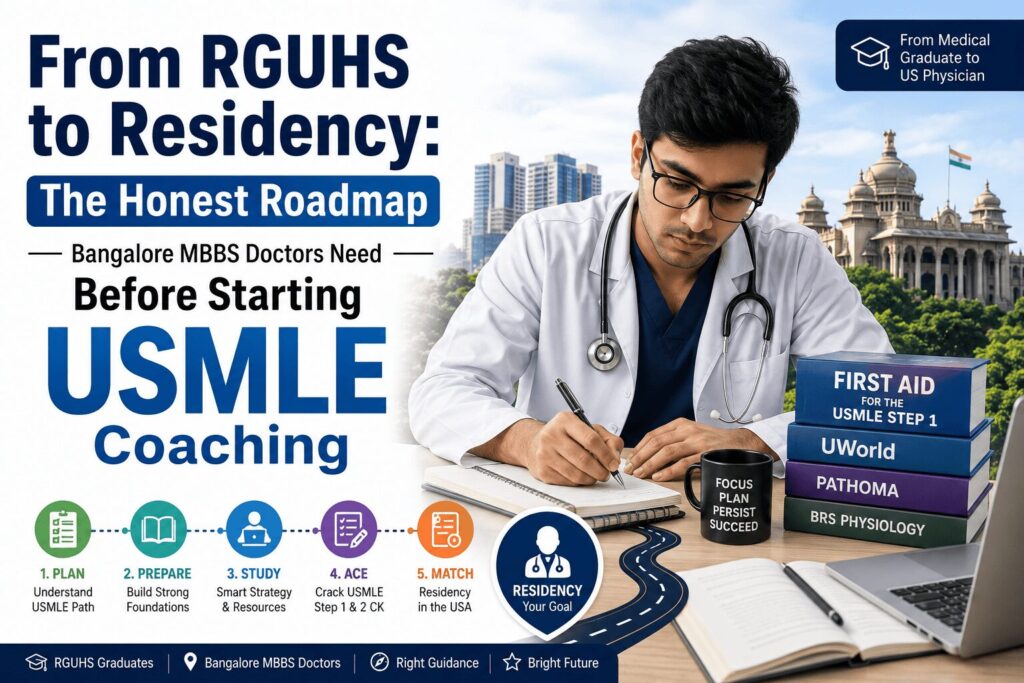
An RGUHS MBBS degree is internationally recognized and eligible for USMLE, which is why a growing number of Bangalore-trained doctors are pursuing US residency. But “eligible” isn’t the same as “easy.” Between ECFMG certification, Step 1 and Step 2 CK, US clinical exposure, and the residency Match, the real roadmap from RGUHS to residency takes 2–4 years of disciplined, self-directed effort and most students only learn the full sequence after they’ve already enrolled in coaching. Here’s the roadmap laid out honestly, before you start.
Why This Roadmap Needed to Be Written
Search “USMLE coaching in Bangalore” and you’ll find dozens of ads promising “Step 1 in 6 months” or “Match guaranteed.” What you won’t find easily is a plain-language sequence of what actually has to happen, in what order, and how long each stage realistically takes for someone starting from an RGUHS-affiliated college.
This is that roadmap written for the RGUHS student sitting in a Bangalore Medical College, MS Ramaiah, St. John’s, Rajarajeswari, or any of the university’s affiliated institutions, trying to decide whether to walk this path.
Step 0: Understand What You’re Actually Eligible For
Rajiv Gandhi University of Health Sciences is Karnataka’s dedicated health sciences university, affiliating a very large network of medical, dental, nursing, and allied-health colleges across the state. An MBBS degree from any RGUHS-affiliated college is recognized by the National Medical Commission for practice registration across India and, importantly, it is also accepted by international licensing bodies, including the USMLE pathway in the US, PLAB in the UK, AMC in Australia, and the Gulf licensing authorities.
In plain terms: your degree is not the bottleneck. The exam, the certification process, and the Match are.
The Real Roadmap: Six Stages From RGUHS to a US Residency
Stage 1 — Build Your Foundation During MBBS (Years 2–4)
USMLE Step 1 covers basic sciences like anatomy, physiology, biochemistry, pharmacology, pathology, microbiology subjects you’re already studying for your RGUHS university exams. The smartest use of your pre-clinical and para-clinical years isn’t cramming a separate syllabus; it’s studying your MBBS subjects with USMLE-style application-based thinking layered on top, using resources like First Aid and organ-system question banks alongside your regular coursework.
Stage 2 – Clear Step 1 (Timing Flexible, Ideally Final Year or Internship)
Step 1 is now pass/fail, which changes the strategy: it’s a gatekeeping exam, not a scoring exam. Passing is mandatory, but your energy from this point on shifts toward Step 2 CK, since that’s the score residency programs will actually evaluate you on.
Stage 3 – Clear Step 2 CK (During or Right After Internship)
This is the exam that carries real weight in your residency application. It tests clinical knowledge across internal medicine, surgery, OB-GYN, pediatrics, psychiatry, and preventive medicine closer to how you’ll actually think as a treating physician. Most successful IMG candidates treat Step 2 CK preparation as seriously as final MBBS exams, often more so.
Stage 4 – ECFMG Certification
Once you’ve cleared the required Steps and met the document requirements (degree verification, medical school listing in the World Directory of Medical Schools, etc.), you apply for ECFMG certification the credential that confirms you’re eligible to enter the US residency Match as an international medical graduate.
Stage 5 – Build US Clinical Experience
This is the stage most Bangalore students underestimate. Observerships, externships (hands-on US clinical rotations), and ideally some research or publications are close to essential for a competitive residency application today. Arranging these from India cost, visas, timing around your internship, letters of recommendation from US-based physicians takes as much planning as the exams themselves.
Stage 6 – Apply Through the Residency Match (NRMP)
You register, submit your application through ERAS, interview with programs (often virtually first), and rank your preferences. The Match algorithm then places you or doesn’t. Clearing every exam does not guarantee a Match; IMGs compete for a limited pool of positions against strong applicants from US and Canadian schools each cycle.
What Coaching Ads Don’t Tell You Before You Sign Up
- “Step 1 in 6 months” ignores Step 2 CK, ECFMG, and the Match. A coaching program’s job usually ends at exam prep the clinical experience and application stages are on you.
- A pass on Step 1 doesn’t offset a weak Step 2 CK score. Programs now scrutinize Step 2 CK, research, and recommendation letters far more closely since Step 1 became pass/fail.
- Unmatched is a real outcome, not a rare one. Some well-prepared IMG candidates go through a cycle without matching and have to strengthen their application before reapplying.
- The financial runway is longer than the coaching fee. Exam fees, ECFMG certification charges, US travel for externships, application costs through ERAS, and Match fees add up across multiple years budget for the full roadmap, not just Stage 2.
- Quality of USMLE Step 1 coaching in Bangalore varies enormously. Before enrolling anywhere, ask for verifiable Match outcomes of past students, faculty who’ve actually gone through the US residency system, and a curriculum built around NBME self-assessments rather than video-lecture volume alone.
A Realistic Timeline at a Glance
| Stage | What Happens | Typical Duration |
| Foundation building | MBBS coursework + Step 1 content overlap | Ongoing through MBBS |
| Step 1 | Pass/fail basic sciences exam | 6–12 months of focused prep |
| Step 2 CK | Scored clinical knowledge exam | 6–12 months of focused prep |
| ECFMG certification | Document verification + eligibility confirmation | A few months, once Steps are cleared |
| US clinical experience | Observerships/externships, research | 6–18 months, often overlapping with exam prep |
| NRMP Match | Application, interviews, ranking, results | One full application cycle (roughly a year) |
| Total (RGUHS to Match) | Roughly 2 to 4 years |
Should You Start USMLE Coaching Now, or Wait?
There’s a reasonable case for starting early the earlier you begin building Step 1 foundations, the less separation there is between your MBBS learning and your USMLE prep. But “starting coaching” and “starting a lifelong commitment” are different decisions.
A sensible approach many RGUHS students take:
- Attend a few trial classes or diagnostic sessions with more than one USMLE coaching program in Bangalore before committing to a long-term batch.
- Take an early practice NBME to get an honest baseline not a marketing promise of where you stand.
- Talk to at least two or three RGUHS alumni who’ve actually gone through the Match, not just cleared Step 1.
- Decide with a full-roadmap view (all six stages above), not just “how do I pass Step 1.”
Frequently Asked Questions
Q1. Is an RGUHS MBBS degree valid for USMLE?
Ans: Yes. RGUHS is Karnataka’s affiliating health sciences university, and its MBBS degree is recognized internationally, including for the USMLE pathway, alongside PLAB, AMC, and Gulf licensing bodies, provided the medical school is listed in the World Directory of Medical Schools and other ECFMG documentation requirements are met.
Q2. How long does it take to go from RGUHS MBBS to a US residency?
Ans: Most candidates need roughly 2 to 4 years after MBBS to clear Step 1 and Step 2 CK, complete ECFMG certification, gain US clinical exposure, and go through the NRMP Match. Timelines vary based on individual pace, retakes, and Match outcomes.
Q3. Should I join USMLE Step 1 coaching in Bangalore during MBBS or after internship?
Ans: Many Bangalore-based RGUHS students start building Step 1 foundations during their pre-clinical and para-clinical years, since the content overlaps with the MBBS syllabus, then intensify formal Step 1 coaching closer to final year or internship when they can dedicate focused study time.
Q4. Does clearing Step 1 guarantee a US residency?
Ans: No. Step 1 is now pass/fail and is only one part of the process. Step 2 CK performance, US clinical experience, research, and recommendation letters all factor into whether you successfully match through the NRMP.
Q5.What should I check before choosing a USMLE coaching institute in Bangalore?
Ans: Ask for verifiable Match outcomes of previous students (not just Step 1 pass rates), confirm faculty have real US residency system experience, and check whether the program includes structured NBME-based progress tracking rather than lecture volume alone.